Mind Body Connection and Exercise — Part One
(Whiplash, Fibromyalgia, Balance, Kinesthesia)
By Dan Watt, B.A., Level 2 ACE PT
Edit and pictures by Andraya Watt, BA, Research Specialization
* This article is based on personal observations.
The second time I got whiplash I found it hurt every time I did certain exercises, especially arm curls and back rows. I didn’t want to give up weight training so I had to find a way to adapt.
Whiplash is a neck injury due to forceful, rapid back-and-forth movement of the neck, like the cracking of a whip (Mayo Clinic). In my case it affected my neck and between my shoulder blades. For others it can also cause severe headaches.
Years ago I was talking to Keri Martin Vrbanac, registered physiotherapist, pelvic floor physiotherapist, and owner of A Body In Motion about doing a guest workshop on whiplash and headaches. She recommended registered physiotherapist Wendy Perry, MPT CAFCI. Wendy did a fantastic workshop on Post Injury Headaches and Neck Injuries. For me the eye opener was that to determine the actual location of the injury she needed to know the position of the body upon impact and in what direction the impact occurred after a car accident, sports injury, or fall. For example, if someone was in a car accident Wendy needed to know where the patient was sitting, what direction they were facing, and in which direction the car was struck. The area a patient complains about can be referred pain and is not necessary the area of the body that is causing the pain.
Upon impact the body immediately goes into protection mode. Muscles tense up, and swelling often occurs.
There are tiny muscles along the spine: intertransversarii, rotatores, multifidus, and interspinales. I wonder if these tiny muscles, like that of the rotator muscles of the shoulder joint: supraspinatus, infraspinatus, supraspinatus, teres minor take a long time or never fully heal.
After training a number of clients with fibromyalgia I noticed similarities between it and whiplash.
Fibromyalgia is considered a disorder characterized by widespread musculoskeletal pain accompanied by fatigue, sleep, memory and mood issues. Researchers believe that fibromyalgia amplifies painful sensations by affecting the way your brain and spinal cord processes painful and nonpainful signals. (Mayo Clinic)
Constant stress or worry that leads to fatigue can cause continuous pain. The habit of holding ones breath and tensing all the time hinders the muscles from releasing. This means neck muscles are constantly contracted which can cause the upper traps to engage.
I was given a new client and immediately noticed that his neck muscles were all bunched up (contracted). I told him to relax his traps, let his neck stretch out, and to make sure he’s breathing. As soon as he relaxed his upper traps and focused on his breathing he immediately felt better and stood taller. Now he knew the importance of destressing and breathing. Stress had caused him to keep his muscles contracted all the time. Proper breathing is absolutely imperative. Holding the breath can hinder oxygen to the brain and working muscles. It can also affect your balance.

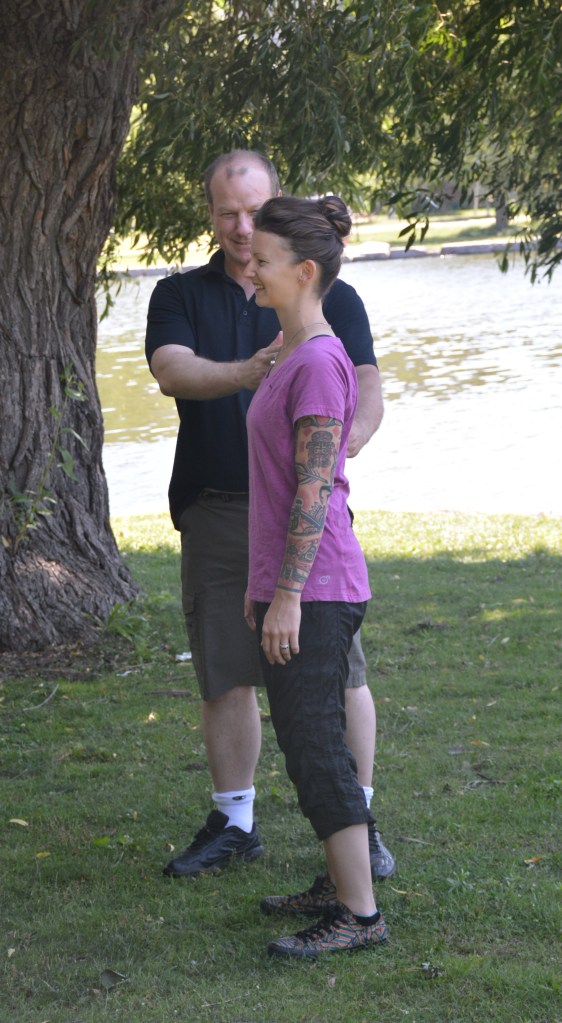
The Author with Taylor Norris, RMT explaining the importance of keeping neutral posture (Victoria Park, Kitchener).
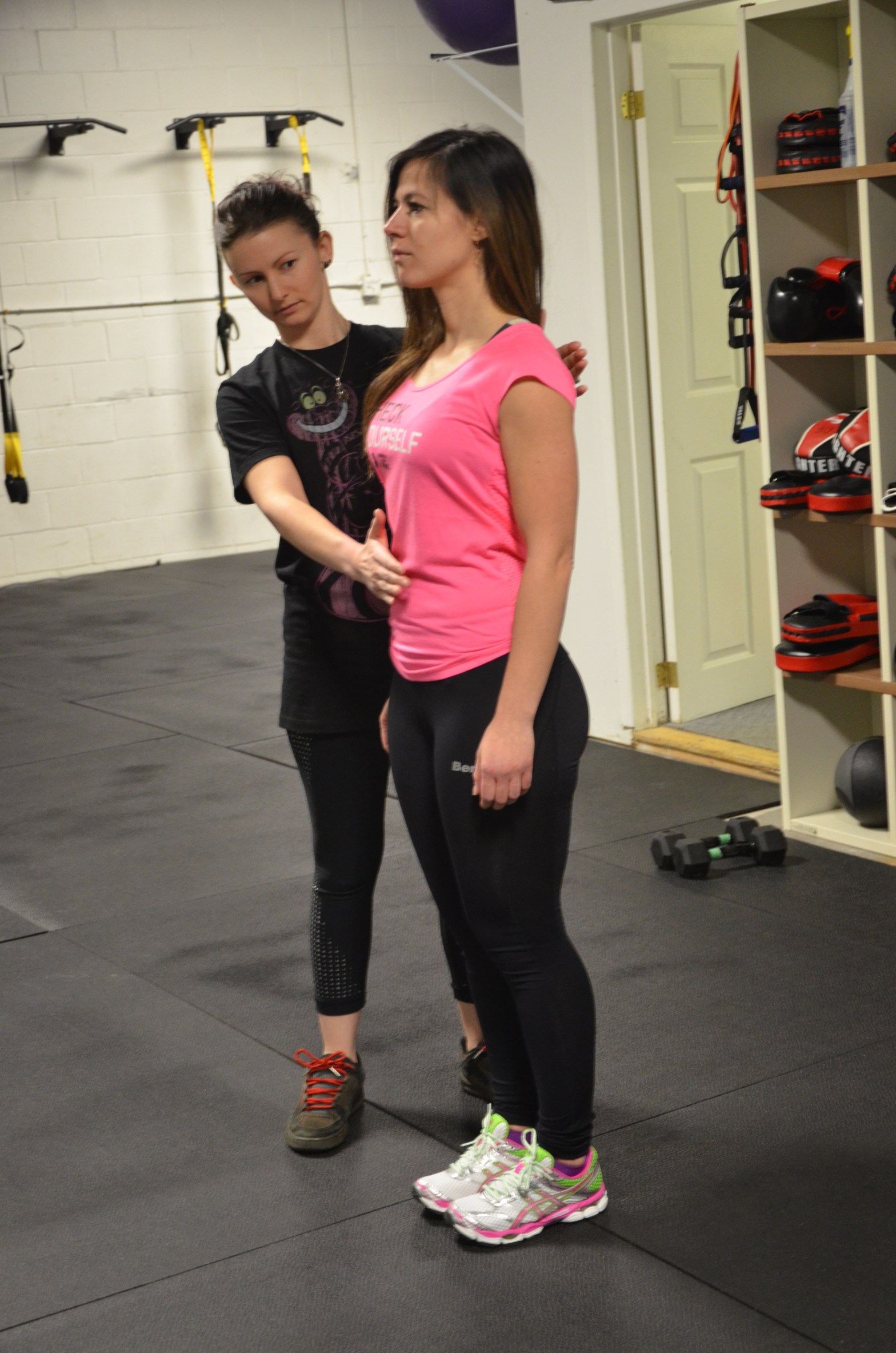
The idea of keeping the spine in neutral position is to allow your opposite muscles to strengthen equally, so the nervous system doesn’t get pinched, the organs aren’t squeezed up, and the arteries and veins can flow smoothly.
Because stress/pain can cause the holding of the breath which can lead to constricting muscles to fatigue it’s very important to remember to breathe.
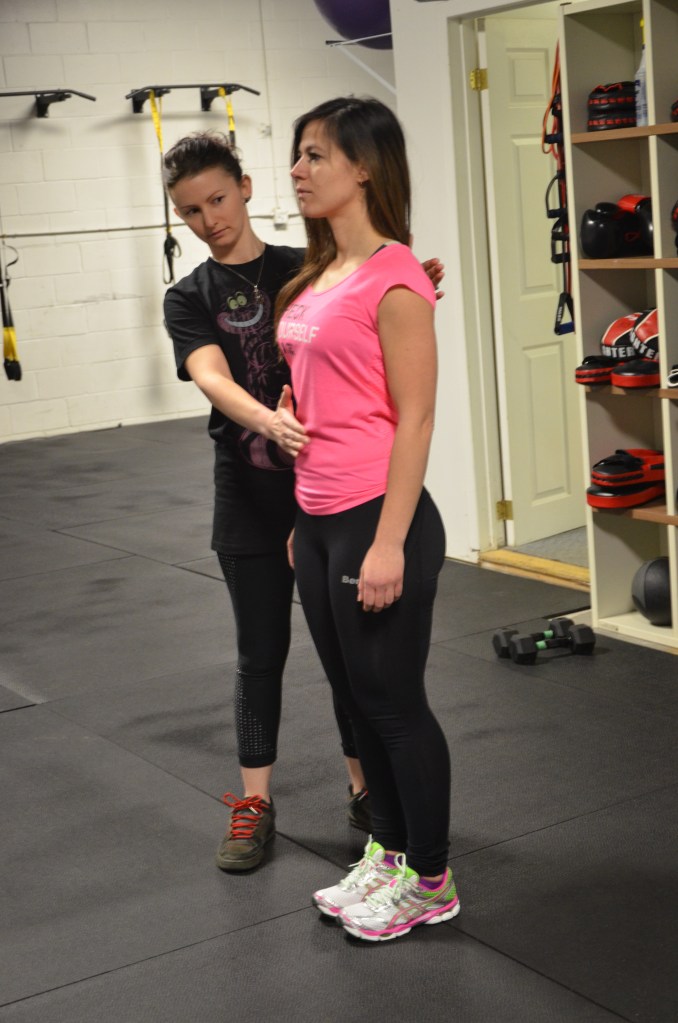
Taylor Norris, RMT and Dr. Arla Kasaj demonstrating Neutral Posture
(Fetter Fitness, Kitchener, Ontario)
I need so many credits every two years to keep my ACE certification. One year I took a yoga course. Two things I learned from the course were the importance of keeping the spine stretched out from the tailbone up (neutral posture) and breathing. My friend and yoga guru Gail Wijesundera recommended that I learn about Pilates. Pilates is a series of exercises that uses specific breathing techniques: inhaling is for protection and exhalation is for movement. Inhaling is used when moving a limb away from the body for stabilization; exhalation occurs when returning the limb towards the centre of the body. This is also a good way to remember to breathe while exercising.
Do a stretch that you know won’t cause you pain. Stretch as far as you can then hold the stretch. Inhale (stabilize) then see if you can gently stretch farther by exhaling (relax). Remember in Pilates you inhale as you move a limb away from your body (to stabilize) and exhale as you bring the limb closer to your body.
As an experiment try this. Exhale as your raise one arm upwards until it’s parallel to the floor or raise it to the side and inhale as you lower it back to your side. Now inhale as you raise the arm and exhale it as you move it back to your side. Did you feel more stable when you exhaled, or when you inhaled as you raised the arm?
Try one more example that’s similar to the breathing technique for Pilates. Inhale as you raise your arm to parallel but this time, continue to raise your arm. As your arm moves past parallel exhale until your arm is above your head.
Let’s look at the importance of Kinesthesia and balance.
Kinesthesia is the awareness of the position and movement of the parts of the body by means of sensory organs (proprioceptors) in the muscles and joints. (Oxford Languages)
I trained a client who seemed to walk without any problem. However, I learned he had lost both his legs below the knees from diabetes. This meant he had to rely on his hips to move.
To walk, squat, balance on one foot, you need to be able to engage your core to stabilize. However you need the gluteus muscles, hip flexors, abductors and adductors and rotator muscles of the pelvic area to do the actual movements.
Sit on a chair away from the back rest and raise one leg. That’s hip flexor contraction (flexion). Move your leg to the side. That’s your abductor muscles contracting.
Now stand up. Hold onto the back of the chair if you need to, and raise your leg to the side. That’s your gluteus medius. The gluteus medius not only helps you move your leg to the side (abduction) but it also stabilises you when you walk.
Still standing, move your leg back without bending your knees (extension). You should feel your gluteus maximus contracting (your butt or rump muscles).
When you walk forward, step sideways, step back, or turn your brain needs to send the signal to the main core muscles: oblique, rectus abdominis, multifidus, and transverse abdominis to keep you balanced.
If the core and other muscles needed to walk and step in different directions are injured or generally unused the brain will limit the signal and prioritize the muscles you are using. Your quads or thigh muscles (top of the leg) and hamstring muscles (back of the leg) might contract but you’ll feel unstable because the core is not engaging.
If you have whiplash be careful trying this experiment (don’t do it if you know it will hurt). Doing certain movements can cause pain and irritation for hours to days for individuals with whiplash and fibromyalgia.
Get a towel, a low tension strength band, or a dowel (you could unscrew the brush of a broom and use the handle). Hold the towel, strength band, or dowel above your head. Pull towards the top of your chest until your arms are bent ninety degrees. Stop before your shoulders roll forward and hold. Someone with whiplash or fibromyalgia (with a trigger point in their neck) will automatically tense their upper traps.
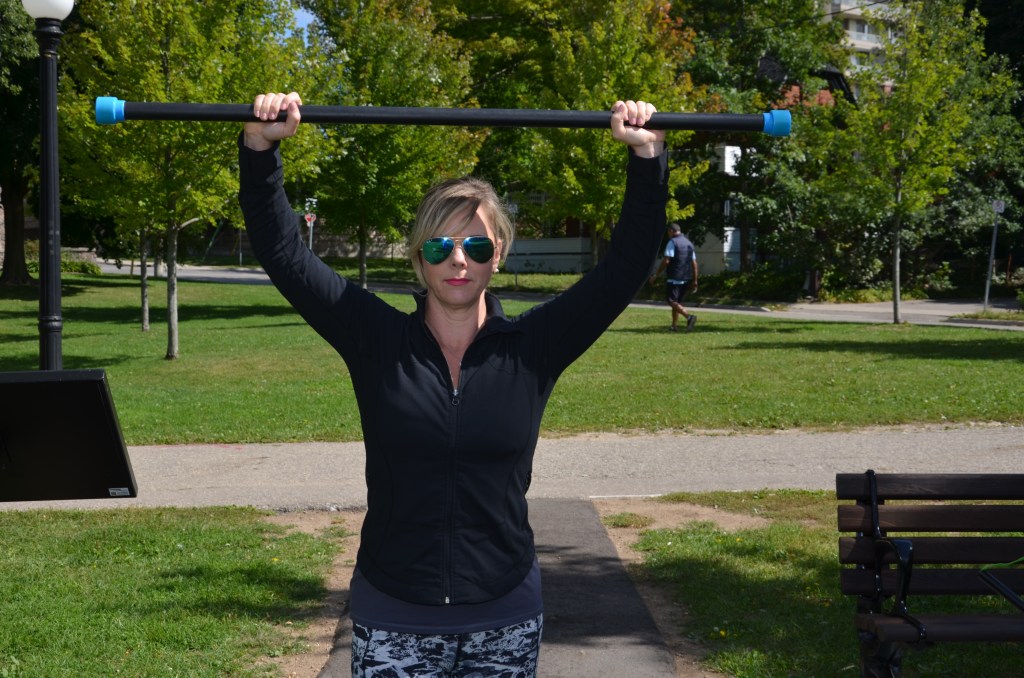
Theresa Coon demonstrating the Lat. Pulldown with a aerobic bar
(Victoria Park, Kitchener, Ontario)
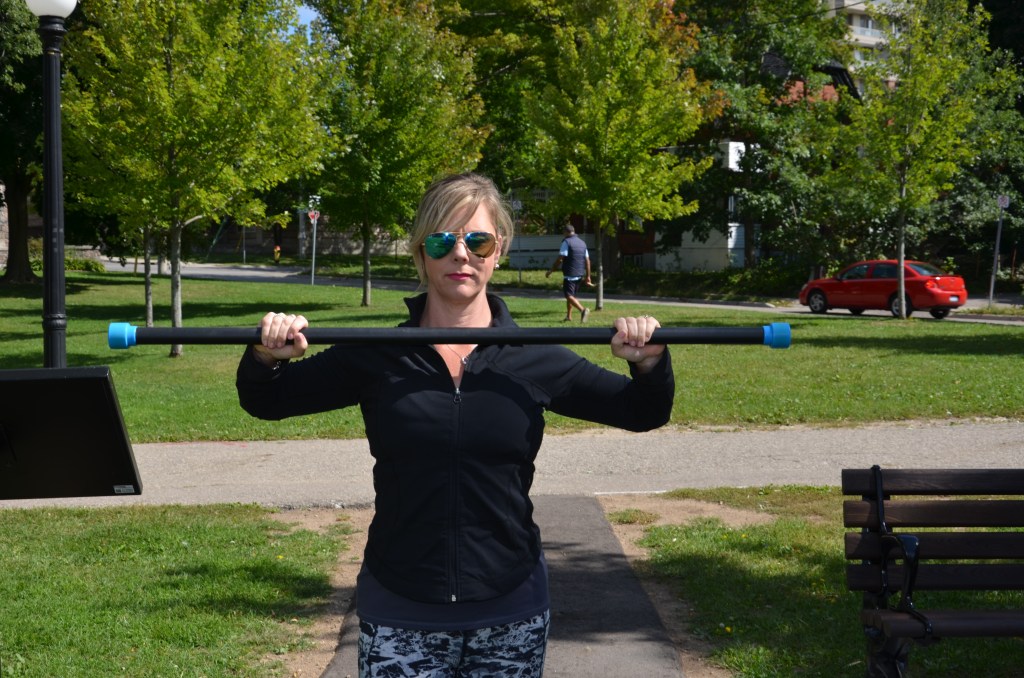
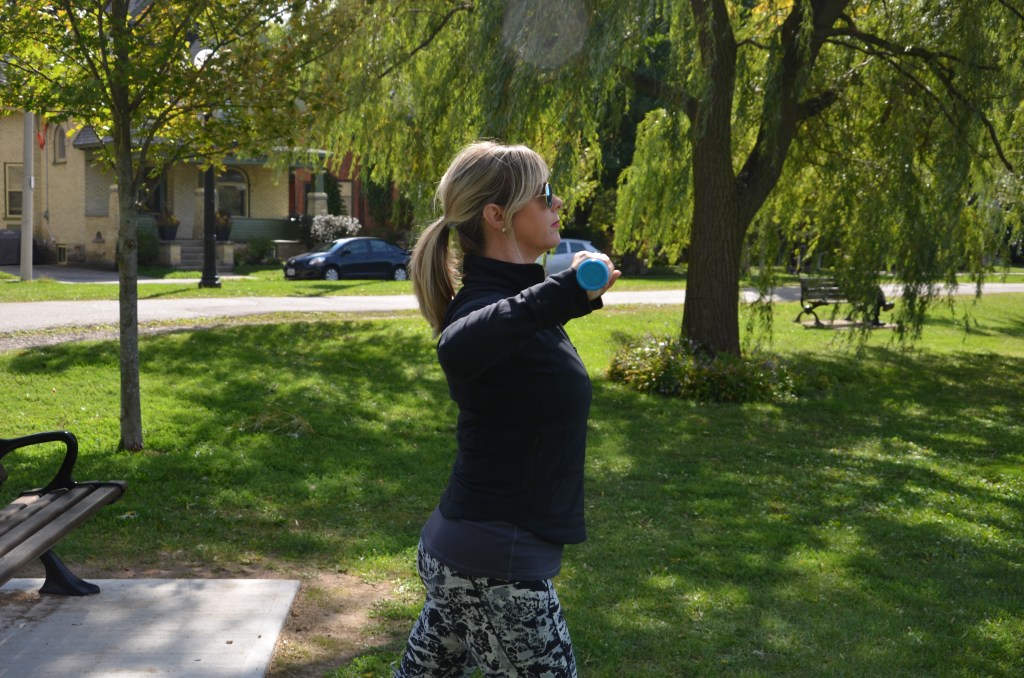
If you find your chin dropped and your upper traps are engaged, try this. Make sure you aren’t holding your breath and push your chest up while you roll your shoulders back. Rolling your shoulders back should disengage the contraction in your upper traps and cause the mid trap and rhomboids between your shoulder blades to contract. Now your latissimus dorsi (wings—the large muscles in your back just under the armpit) should engage instead of the upper traps.
One thing I found that helped me avoid pain and heal my whiplash injury was to inhale when curling the arms or pulling with the back. Remember inhaling stabilizes while exhaling relaxes. I found by inhaling I could stretch out my spine so I felt the biceps or lats contracting instead of the upper traps. This either stopped me from feeling debilitating pain or made the pain far less and recovery much quicker.
This has nothing to do with exertion because generally exhaling is considered better for exertion (concentric) while inhaling is better for the return to the original position (eccentric).
The importance of understanding the body has a great deal to do with balance. Remember the word Kinesthesia and what that means. Think of martial artists, dancers, figure skaters, and gymnasts. In each sport the athlete needs to have the ability to balance on one foot.
Does the brain send a single to the balancing foot, the pelvic area, or the raised foot? In yoga there is the tree pose. If you can do it raise one foot off the ground and hold it there for a moment while you think about where the brain needs to send a signal in order to balance. My experience for myself and clients is that only the pelvic area needs to be contracted (not excessively just enough to stabilize the body).
If you watch dancers or martial artists their movements are fluid and from the pelvic area.
Place your hand on something stable and grab on really tight. At the same time lift one of your feet off the floor. Where is the signal from the brain going first? What happens when you do this is that the signal to the nervous system in your stabilizing muscles will be minimal. With your one foot still raised start to loosen your hand. See if your core starts to engage more.
I suggest if you can’t quite balance on one foot you put one hand on a stable surface and practice lifting one foot at a time. Gradually raise the supporting hand just off the surface so you can grab onto it if you need to as you lift one foot at a time. Your body will start to utilize the nerve signals to your core again.
One last experiment. Lie on a carpet or mat with your knees bent and your feet on the floor (make sure your feet are parallel and toes aligned so that one foot isn’t ahead of the other). Put both arms against your sides. Raise your left arm up and back until it touches the floor (don’t force it just let gravity gently pull it down). Switch arms. Next put your hands under your head so you’re doing a chest stretch. Relax your arms and your back. See if you feel a jolt or uneven tension. This may take upwards of five to ten minutes. Stretch both your legs out and just relax the body. Make sure you’re breathing evenly. By keeping your spine in alignment and your feet lined up your body will relax so the tight muscles release.
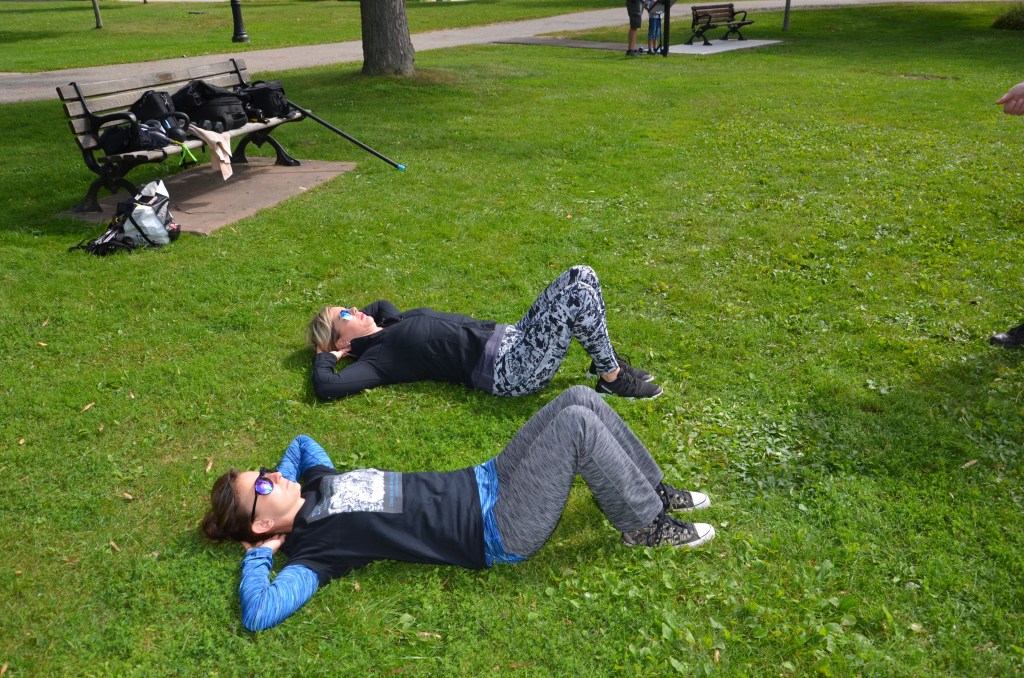
Taylor Norris, RMT and Theresa Coon
In conclusion: focus on stretching the body up from the soles of the feet all the way through the tailbone to the base of your skull (but don’t lock out your joints); remember to breathe as you exercise and throughout the day; challenge all your muscles by doing a variety of exercises; and practice balancing. This should help avoid or at least alleviate pain caused from whiplash and fibromyalgia.
At some point we’ll make a video demonstrating the exercises and stretches.
Dan Watt is a Level 2 ACE personal fitness Trainer. If you have questions are interested in training he can be reached at: dwexercise@gmail.com
Thanks to:
Taylor Norris, RMT (co-blogger of twhealthhumor) taynorris@gmail.com
Dr. Arla Kasaj-deJonge, ND RAc akwellness@gmail.com
Theresa Coon Theresa.coon2@gmail.com
Suggested individuals to look up from courses I have taken:
Stuart McGill, PhD
Paul Check (Check Institute)
Anthony B. Carey, M.A., C.S.C.S
 NWHealthFitness